Having a great story idea is exciting, but turning that idea into a complete novel is an entirely different challenge. You may have imagined the mysterious fae kingdom, the dangerous prince, the impossible magical bond, the enemies-to-lovers tension, and the dramatic moment when the two characters finally admit what they feel. The problem usually begins when you open a blank document and realize you have no idea what should happen in Chapter 1, how the middle of the story should develop, or how to bring all those ideas together into a satisfying ending.
That is exactly the problem Fae Romance Booksmith AI is designed to address. Rather than functioning like a generic AI writing tool that simply generates paragraphs of fiction from a short prompt, Fae Romance Booksmith AI takes a more structured approach. It guides you through a seven-stage process designed specifically around the needs of Fae romance storytelling. The system helps you move from an initial concept to characters, worldbuilding, tropes, plot structure, chapter planning, and finally the ending.
The biggest idea behind the product is simple: you already have the imagination; what you need is a framework for organizing it.
Fae Romance Booksmith AI is therefore aimed at people who have a story living inside their head but struggle to turn that story into something they can actually write. You do not need to arrive with a perfectly developed premise. According to the product information, even a vague mood, image, character idea, or simple “what if” can be used as the starting point.
The system then helps you develop that spark into a fully structured novel blueprint that you can use as the foundation for writing your own book.

Fae Romance Booksmith AI Review 2026 – Overview

| Creator | AnnaQuinn |
| Product | Fae Romance Books |
| Launch Date | 08/26/2026 |
| Launch Time | 09:00 AM (US Central Time) |
| Official website | CLICK HERE |
| Front-End Price | $12.95 |
| Bonuses | Yes, Huge Software Bonuses >>Check Below<< |
| Skill | All Levels |
| Guarantee | 30-Day Money Back Guarantee |
| Niche | Humantar Tool |
| Support | Еffесtіvе Rеѕроnѕе |
| Recommend | Highly recommend! |
Fae Romance Booksmith AI Review 2026 – What is it?
Fae Romance Booksmith AI is an AI-guided novel planning and structuring system created specifically for Fae romance writers. Its purpose is not to replace the author or automatically produce a complete publish-ready manuscript. Instead, it is designed to help writers organize their ideas into a coherent story blueprint that can eventually be turned into a full novel.
This distinction is important because there are countless AI writing tools that promise to generate stories, chapters, articles, scenes, and even entire books. The problem with simply asking an AI to “write a Fae romance novel” is that the resulting story can feel disconnected, generic, or lacking in a strong underlying structure. You may get thousands of words, but that does not necessarily mean you have a good novel.
Booksmith takes the opposite approach.
Rather than beginning with a huge block of generated prose, it asks the writer to make decisions about the story. What is the central concept? Who are the characters? What do they want? What is keeping them apart? What kind of Fae world are they living in? Which tropes fit the story? What happens when the relationship changes? Where does the major conflict occur? How does the romance resolve?
Those decisions are then organized into a structure.
This makes the product particularly interesting for aspiring authors who already have plenty of imagination but struggle with the mechanics of novel planning.
Imagine having a sentence such as:
“A mortal healer accidentally bonds with the ruthless prince of a winter fae court.”
That sentence is not a novel yet. It is only a spark.
Booksmith is designed to help develop that spark into a hook, protagonists, a Fae court, magical rules, romantic tension, conflicts, plot beats, chapters, and an ending.
That is the fundamental promise of the product.
It doesn’t replace your story. It helps give your story a shape.
The Problem Fae Romance Booksmith AI Is Trying To Solve
One of the biggest problems facing new fiction writers is not a lack of ideas. In many cases, the opposite is true.
They have too many ideas.
A writer may imagine a dangerous Fae prince, a mortal heroine, a forbidden bond, rival courts, ancient magic, political intrigue, a prophecy, an arranged marriage, and a dramatic betrayal. Everything sounds amazing when it is inside their head.
But when they sit down to write, those ideas can become overwhelming.
Which idea comes first?
What is the inciting incident?
How quickly should the romance develop?
What should happen in the middle?
When should the characters discover the secret?
What causes the relationship to break?
How does the final conflict connect to the romance?
How should the story end?
These questions can cause a writer to spend weeks researching writing structures without actually writing.
Fae Romance Booksmith AI attempts to reduce that friction by breaking the process into seven manageable stages.
Instead of thinking:
“I have to plan an entire novel.”
the writer only has to think:
“What do I need to decide on this page?”
That is a much more manageable creative process.
Fae Romance Booksmith AI – The Seven Pages of Your Grimoire
The central mechanism behind the product is called The Seven Pages of Your Grimoire.
These seven pages represent the major components needed to turn a rough Fae romance concept into a structured novel blueprint.
The system takes the writer through:
Concept → Characters → World → Tropes → Plot → Chapters → Ending
Each stage serves a different purpose, and together they form the backbone of the novel.
Let’s look at each stage in detail.
1. The Spark – Concept Development
The first stage is called The Spark, and its purpose is to take the initial idea and make it strong enough to serve as the foundation of the story.
This is particularly useful because many writers don’t begin with a polished premise. They begin with a feeling.
Maybe they want to write about a mortal woman who enters a forbidden Fae kingdom. Maybe they have an image of a beautiful but dangerous prince. Maybe they have a magical bond in mind. Maybe they simply know they want an enemies-to-lovers romance involving a Fae court.
Booksmith is designed to work with that early-stage idea.
The concept stage helps turn the vague idea into something more defined by establishing the central hook and direction of the story.
This matters because a strong concept gives the rest of the novel something to build around.
Once you understand what the story is really about, it becomes easier to develop the characters, world, conflict, romance, and plot.
Instead of endlessly adding random ideas, you have a central premise that can guide your decisions.
2. The Bound Souls – Character & Bond Development
The second stage focuses on characters.
Good romance depends heavily on the relationship between the main characters. Beautiful worldbuilding alone cannot carry a romance novel if the characters don’t have believable motivations, emotional wounds, desires, conflicts, and chemistry.
Fae Romance Booksmith AI approaches character development through the lens of the relationship.
Rather than stopping at superficial information such as hair color, clothing, age, or appearance, the system is designed to explore the deeper reasons behind the characters’ actions.
What does the heroine want?
What does the hero fear?
What emotional wound influences their behavior?
Why are they attracted to each other?
Why should they resist each other?
What keeps them apart?
What changes as they spend more time together?
These questions help create the foundation for romantic tension.
For example, a ruthless Fae prince might desperately need the heroine because of a magical bond, while simultaneously hating the vulnerability created by that bond. The heroine may want nothing more than freedom, yet discover that leaving the court could have devastating consequences.
Now the romance is connected directly to the story conflict.
That is much more powerful than simply saying two attractive characters meet and fall in love.
3. The Realm – World & Court Building
Fae romance often depends heavily on the world.
Unlike contemporary romance, where the story may take place in a familiar city or workplace, Fae romance can involve completely fictional kingdoms, courts, magical laws, ancient bargains, supernatural politics, magical creatures, curses, bloodlines, and supernatural rules.
That creates incredible creative possibilities—but it can also create a huge problem.
Worldbuilding can become overwhelming.
A writer can spend days creating maps, histories, royal families, magical systems, languages, political structures, and hundreds of years of fictional history without moving the romance forward.
The third page, The Realm, is designed to keep worldbuilding connected to the actual story.
Instead of encouraging endless lore for its own sake, the goal is to establish the courts, magic, politics, and rules that matter to the novel.
For example, if the central conflict involves a magical bond between a mortal healer and a Fae prince, then the rules governing that bond become important.
If the Fae court has a law that treats accidental bonds as a form of conquest, that law directly affects the heroine.
If the prince is bound by a vow that prevents him from abandoning his kingdom, that vow affects his choices.
The world therefore becomes part of the romance rather than merely being decorative background.
4. The Old Magic – Tropes & Romance Blueprint
Fae romance readers often have strong expectations about the types of stories they enjoy.
They may love:
- Enemies-to-lovers
- Fated mates
- Accidental bonds
- Forced proximity
- Forbidden romance
- Political marriages
- Dangerous Fae princes
- Mortal/Fae relationships
- Magical bargains
- Rival courts
- Slow-burn attraction
Tropes can be powerful because they immediately communicate the type of emotional experience a reader can expect.
But simply throwing several popular tropes into the same book doesn’t automatically create a good story.
The fourth stage, The Old Magic, is designed to help writers select and combine tropes intentionally.
The purpose is to make the tropes work together with the characters and plot rather than becoming a disconnected checklist.
For example, an accidental bond can create forced proximity. Forced proximity can increase romantic tension. Political pressure can make the relationship dangerous. A magical bargain can create a future betrayal.
Now the tropes aren’t just decorations.
They are driving the story.
That is an important distinction for romance writers who understand what tropes they enjoy but aren’t sure how to build a complete plot around them.
5. The Thread of Fate – Plot Structure
Once the concept, characters, world, and tropes are established, the next challenge is turning those ingredients into a story.
This is where The Thread of Fate comes into play.
The plot stage provides a romance-focused structure designed to help writers identify the important turning points of their story.
A novel needs more than an interesting beginning.
Something needs to change.
The relationship needs to evolve.
The stakes need to increase.
Secrets need to be revealed.
Characters need to make difficult choices.
Eventually, something has to break before the story can move toward its resolution.
Booksmith helps organize these elements into a plot spine.
For a Fae romance, that might look something like:
The bond forms → the court claims the heroine → the characters resist each other → trust begins developing → a major secret is discovered → betrayal occurs → the bond is threatened → the characters make a final choice → the relationship and larger conflict are resolved.
The exact story will depend on the writer’s answers, but the important part is having a structure that connects the events.
This can be especially useful for writers who know how their novel should begin but have no idea what should happen after the first few chapters.
6. The Pages Written – Chapter-by-Chapter Map
Having a plot outline is helpful, but many writers still become stuck when it is time to write individual chapters.
A broad outline might tell you:
“The heroine discovers the prince’s secret.”
But what happens in the chapter?
Where does the scene begin?
What emotional change occurs?
How does the romance progress?
What information does the reader learn?
What changes by the end of the chapter?
The sixth stage, The Pages Written, translates the broader plot into a chapter-by-chapter map.
This gives the writer a clearer understanding of what each chapter is supposed to accomplish.
Instead of sitting down every morning and asking:
“What do I write today?”
the writer can look at the chapter roadmap and understand the purpose of the next section.
That doesn’t mean every sentence is predetermined.
The writer still creates the prose, scenes, dialogue, descriptions, and final storytelling voice.
The blueprint simply reduces the uncertainty around what should happen next.
7. The Vow – Ending & Epilogue
One of the easiest parts of a story to underestimate is the ending.
A novel can have an incredible premise and engaging characters but still leave readers disappointed if the final resolution feels rushed or incomplete.
Romance readers especially expect emotional payoff.
If the characters spend hundreds of pages struggling with their relationship, the final resolution needs to feel earned.
The seventh stage, The Vow, is designed to help writers plan that resolution.
The ending should address the major conflict while also delivering the emotional conclusion of the romance.
In the example provided by the vendor, the magical bond is ultimately kept, but the law surrounding it is rewritten so that the final vow becomes a choice rather than captivity.
That illustrates the kind of payoff Booksmith is trying to help writers create.
The ending isn’t simply:
“They lived happily ever after.”
Instead, the resolution should connect back to the central conflict and demonstrate how the characters have changed.

Fae Romance Booksmith AI Review 2026 – Features and Benefit
The front-end product is built around seven primary components.
Concept Spark Generator
The Concept Spark Generator helps transform a rough idea into a more defined story premise.
This can be useful if you know the general vibe of the story but haven’t yet figured out the exact hook.
Character & Bond Architect
This component focuses on developing the protagonists and the relationship between them.
The emphasis is on emotional motivation, conflict, chemistry, tension, and the forces keeping the characters apart.
World & Court Builder
This helps establish the relevant Fae worldbuilding, including courts, magic, rules, and politics.
The goal is to provide enough world structure to support the story without forcing the writer into an endless lore-building exercise.
Trope Library & Blueprint
This helps identify and combine romance tropes in a deliberate way.
The objective is not simply to use every popular trope but to understand how they can support the central relationship and plot.
Plot Thread Mapper
This provides the main structural framework of the novel, including escalation and major turning points.
Chapter-By-Chapter Draft Guide
The chapter guide converts the larger plot into a more detailed writing roadmap.
This is arguably one of the most practical parts of the system for writers who repeatedly become stuck halfway through a novel.
Ending & Epilogue Composer
The final component helps plan the conclusion and romantic payoff so the story has a clearer destination from the beginning.
Fae Romance Booksmith AI – Why Genre-Specific Structure Matters
One of the strongest selling points of Booksmith is that it isn’t marketed as a universal writing template.
It is specifically designed for Fae romance.
That matters because different genres have different expectations.
A mystery novel needs clues, suspects, reveals, and investigations.
A thriller needs escalating danger.
A fantasy epic may require extensive political and worldbuilding structures.
Romance needs emotional progression and relationship development.
Fae romance combines romance with fantasy elements, which means the author has to manage both.
The relationship needs to develop while the magical world remains coherent.
The characters need romantic tension while court politics and supernatural rules create external pressure.
The world needs to feel magical without overwhelming the emotional story.
That combination is exactly where a genre-focused system can be useful.
Fae Romance Booksmith AI – Who Is It Best For?
The product is particularly suitable for aspiring Fae romance authors who have ideas but don’t know how to structure them.
It can also be useful for people who read a lot of romantasy and constantly imagine their own stories but haven’t successfully completed a novel.
Another strong audience is writers who have several unfinished manuscripts sitting on their computer.
These writers may not need more inspiration.
They may need a system that helps them decide which idea to develop and how to move that idea through a complete story structure.
It can also appeal to existing ChatGPT users.
If you’ve already experimented with ChatGPT and discovered that simply asking it to write a novel produces inconsistent or generic results, Booksmith offers a more guided workflow.
Instead of treating AI as the author, the system positions AI as the structuring collaborator.
Fae Romance Booksmith AI – Who Is It NOT For?
Booksmith is not intended to be an instant manuscript generator.
If you are looking for a button that produces a complete, polished, publication-ready romance novel, this product isn’t making that promise.
The sales information is very clear that the buyer receives a structured novel blueprint, not a ghostwritten 70,000-word manuscript.
It also isn’t primarily an editing tool.
Someone who already has a finished manuscript and wants line editing, proofreading, or professional developmental editing may need a different solution.
Likewise, someone who doesn’t want to participate in the creative process probably won’t get the full value from the product.
The system asks questions.
Your answers matter.
Your story remains your responsibility.
Fae Romance Booksmith AI – Price
The front-end offer is priced at $12.95 as a one-time payment.
There is no recurring subscription advertised for the front-end.
That means the buyer isn’t committing to a monthly software bill just to keep access to the initial Booksmith system.
The product also includes a 30-day Seven-Page Booksmith Guarantee.
According to the supplied guarantee terms, customers can request a full refund within 30 days if the Booksmith isn’t right for them.
However, the guarantee does not promise that someone will finish a novel, become a successful author, achieve sales, receive high rankings, or earn money.
Those outcomes depend on the writer and many external factors.
Fae Romance Booksmith AI OTOs – Upsells Explained
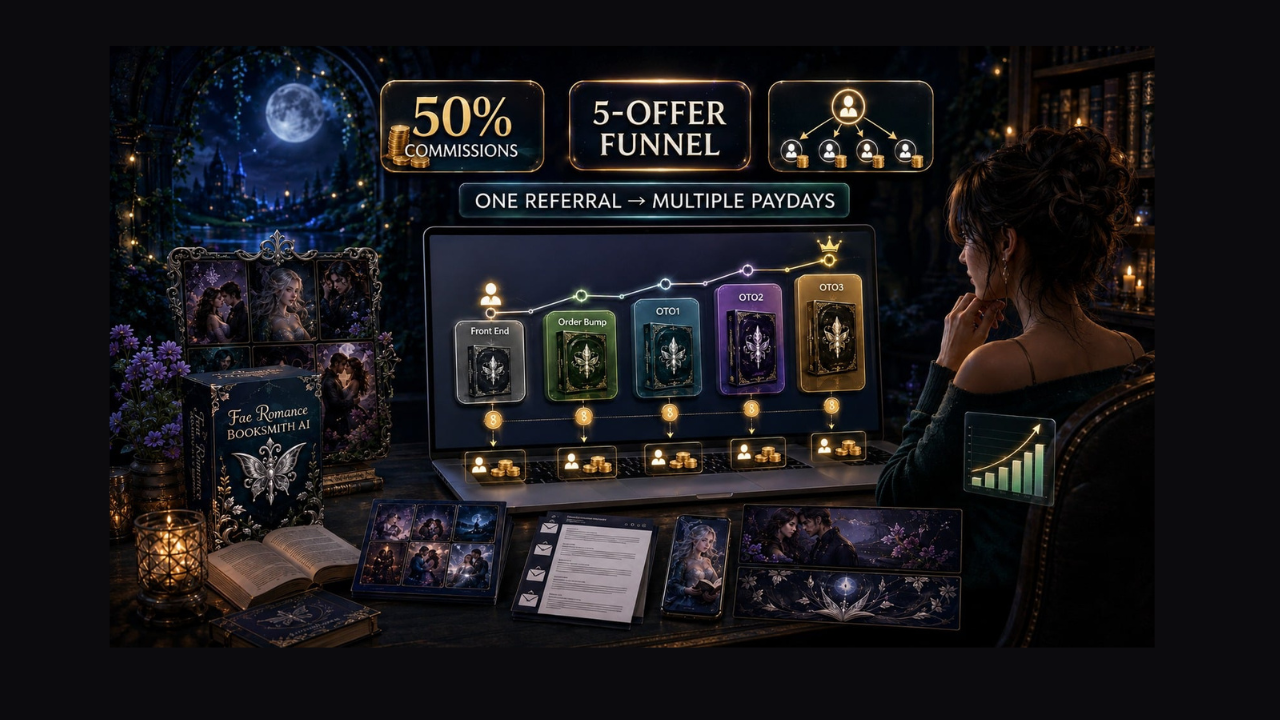
The main $12.95 product is only the beginning of the complete funnel.
There is an order bump followed by three one-click upsells.
These additional products are designed to address different stages of the writing process.
Fae Romance Story Vault – $7.95
The Fae Romance Story Vault is the order bump priced at $7.95.
This offer is aimed at writers who want additional inspiration and story-building material.
According to the supplied information, the vault contains resources such as story premises, tropes, kingdoms, magic systems, twists, and conflicts.
This makes it a natural companion to Booksmith.
For example, a writer might use the Story Vault to find a premise or magical conflict and then take that idea into Booksmith to develop the characters, world, plot, chapter map, and ending.
So rather than replacing the front-end, the Story Vault can provide additional raw material to work with.
Fae Romance Author Pro – $26.95
The first upsell is Fae Romance Author Pro, priced at $26.95.
This product moves beyond planning and focuses more directly on improving the writing itself.
It contains eight tools:
Emotion Amplifier, Dialogue Doctor, Chemistry Builder, Scene Expander, Show-Don’t-Tell Rewriter, Character Voice Lock, Description Enhancer, and Pacing Doctor.
This makes sense as the next stage because once an author has created a structured blueprint, the next challenge is turning that blueprint into engaging scenes and prose.
The Emotion Amplifier can help strengthen emotional moments.
The Dialogue Doctor focuses on conversations.
The Chemistry Builder relates directly to romantic interaction.
The Scene Expander can help develop shorter sections.
The Show-Don’t-Tell Rewriter is intended to improve how information and emotion are presented.
The Character Voice Lock focuses on maintaining distinct character voices.
The Description Enhancer can help enrich descriptions.
And the Pacing Doctor addresses the rhythm of the story.
Together, these tools are designed to help the writer move from planning the novel toward developing the actual manuscript.
Novel Continuity Command Center – $46.95
The second upsell is the Novel Continuity Command Center, priced at $46.95.
This addresses one of the problems that becomes more noticeable as a novel gets longer: continuity.
When you’re writing a 60,000-word or longer manuscript, it becomes easy to forget details.
A character’s eye color may accidentally change.
A magical rule introduced in Chapter 4 might be contradicted in Chapter 38.
A character may appear to know something they shouldn’t know yet.
A timeline can become confusing.
An unresolved subplot can simply disappear.
The Continuity Command Center is designed around eight organizational stations:
- Story Bible
- Character Memory
- Lore
- Timeline
- Magic Rules
- Plot Holes
- Open Threads
- Chapter Recaps
For Fae romance in particular, this can be useful because fantasy stories often contain more world rules and lore than contemporary romance.
If a story includes multiple Fae courts, magical bonds, supernatural rules, ancient bargains, and complicated relationships, maintaining consistency becomes increasingly important.
Fae Romance Series Empire – $66.95
The third upsell is Fae Romance Series Empire, priced at $66.95.
This is aimed at authors who don’t want to stop at one novel.
Instead of planning a single story, Series Empire is designed to help authors think about a larger interconnected universe.
The seven tools include:
- Trilogy Builder
- 5-Book Planner
- Spin-Off Generator
- Crossover Planner
- Series Villain Arc
- Universe Lore
- Book-to-Book Hooks
This can be particularly relevant for authors interested in building a connected series rather than treating every book as a completely separate project.
A first book can introduce the world and main relationship.
A later book can explore another character.
A spin-off can follow a secondary romance.
A larger villain arc can continue across multiple books.
The series-level approach helps the writer think beyond one manuscript.

Price and Evaluation
Genre-Specific
One of the biggest advantages is the specific Fae romance focus. The system is designed around the tropes, relationship dynamics, courts, magical elements, and storytelling expectations associated with the genre.
Beginner-Friendly
You don’t need to arrive knowing exactly how to structure a novel. The guided process is intended to take you through the major decisions step by step.
Helps Solve the Blank-Page Problem
Instead of staring at a blank document and wondering what happens next, you have a predefined sequence of decisions to work through.
Covers the Entire Planning Process
The system doesn’t stop at the premise. It progresses through characters, world, tropes, plot, chapters, and ending.
Keeps Creative Control With the Author
The product is not designed to replace your voice. Your answers and decisions form the foundation of the blueprint.
Affordable Front-End
At $12.95 one time, the initial offer has a relatively low entry price compared with many writing courses or software subscriptions.
30-Day Guarantee
The stated 30-day guarantee gives buyers an opportunity to evaluate the product within the guarantee period.
Fae Romance Booksmith AI – Cons
It Doesn’t Write the Entire Novel
This is probably the biggest limitation for anyone expecting complete automation.
You still have to write the manuscript.
Creative Input Is Required
The system guides you, but it can’t make every creative decision for you.
Fae Romance Focus
Its specialization is also a limitation if you primarily write genres unrelated to Fae romance.
Requires ChatGPT
A free ChatGPT account is required to open and use the Booksmith.
Not a Replacement for Editing
Even after using the blueprint, the resulting manuscript will still require writing, revision, proofreading, and potentially professional editing.
Fae Romance Booksmith AI – Is It Worth It?
Whether the product is worth buying depends heavily on what you expect from it.
If you want a completely automatic AI novelist that generates a polished manuscript with minimal involvement from you, then Fae Romance Booksmith AI is not positioned for that purpose.
But if you have an idea and your biggest obstacle is structure, the product becomes much more compelling.
The real value is in reducing the number of decisions you have to make simultaneously.
Writing an entire novel can feel enormous.
Planning a concept is manageable.
Developing two characters is manageable.
Defining the relevant world rules is manageable.
Choosing the right tropes is manageable.
Mapping the major plot beats is manageable.
Planning chapters is manageable.
Thinking about the ending is manageable.
When these smaller tasks are connected together, you end up with something much more useful than a collection of random ideas.
You have a roadmap.
And having a roadmap can make the difference between an idea that stays in your Notes app and a project that actually moves forward.
Fae Romance Booksmith AI vs. Generic ChatGPT
It is worth discussing this because the product itself makes this distinction a major part of its positioning.
Technically, a writer could open ChatGPT and ask it to help create a Fae romance.
But the challenge is knowing what to ask and in what order.
You might ask for character ideas.
Then worldbuilding.
Then plot ideas.
Then chapters.
Then you might realize the character motivation contradicts the plot.
You ask another prompt.
Then another.
Eventually, you have dozens of conversations and fragments but no unified blueprint.
Booksmith attempts to solve this organizational problem by creating a guided sequence.
Instead of asking:
“What should I prompt ChatGPT with?”
the system guides you through the questions that matter.
That is the real differentiation.
The value isn’t necessarily that the underlying AI is magical.
The value is the workflow, organization, and genre-specific structure around the AI interaction.
Fae Romance Booksmith AI – A Realistic Example
Let’s take the product’s example of a mortal healer who accidentally bonds with a ruthless winter Fae prince.
At the beginning, that is simply an intriguing premise.
The Booksmith framework can then expand the idea into a complete story structure.
The heroine becomes Liora Vane, a mortal healer whose primary desire is freedom.
The hero becomes Prince Kael of the Frost Court, a ruthless ruler constrained by a vow and desperate to protect his people.
The court itself has political problems.
The magical bond becomes a source of conflict.
The law surrounding the bond creates a threat to the heroine.
The relationship begins with resistance rather than immediate trust.
As the story progresses, the characters begin to understand each other.
Then a betrayal changes the situation.
The vow breaks.
The characters have to make a choice.
Finally, the ending transforms the meaning of the bond from captivity into a voluntary commitment.
Notice what happened here.
The system didn’t simply generate thousands of words.
It helped answer the questions:
Who?
Why?
Where?
What stands in their way?
What changes?
What happens next?
How does it end?
That is exactly the kind of structural thinking that a new novelist can struggle with.
Fae Romance Booksmith AI – Frequently Asked Questions
Is Fae Romance Booksmith AI a ghostwriter?
No. It is specifically described as a guided structuring and planning system rather than a ghostwriter.
The result is a novel blueprint that the author can write from.
Does it create a 70,000-word novel?
No. The product does not promise a finished 70,000-word manuscript.
It creates the structure between the initial concept and the writing process.
Can complete beginners use it?
Yes. The product is specifically positioned for people who may have little or no fiction-writing experience.
What if I only have a vague idea?
That is one of the situations the first stage is designed for.
You can begin with a mood, image, character, or simple “what if.”
Is this only for Fae romance?
Yes. This edition is specifically designed around the Fae romance genre.
Do I need paid ChatGPT?
No. The supplied information states that a free ChatGPT account is sufficient.
Does it work on mobile?
Yes. The supplied information says the Booksmith can be opened in a browser on a phone or desktop.
Is there a monthly subscription?
No. The front-end is advertised as a $12.95 one-time purchase.
Is there a guarantee?
Yes. There is a 30-day Seven-Page Booksmith Guarantee according to the supplied product terms.
Will Booksmith guarantee that I finish my novel?
No. The product doesn’t guarantee writing outcomes, publication, sales, rankings, or earnings.
Your results depend on your own creative input, writing ability, consistency, revision process, and other factors.
Can I use the blueprint however I want?
The supplied disclaimer explains that the generated concepts, characters, world notes, tropes, plot maps, chapter guides, and ending suggestions are optional aids that the user can accept, revise, or reject.
Fae Romance Booksmith AI Review – Final Verdict
After looking at what the product actually offers, Fae Romance Booksmith AI is best understood as a genre-specific AI-powered novel planning system, not an automatic novel generator.
And that distinction is important.
The product isn’t promising to sit down and write your book while you do nothing.
Instead, it addresses a much more specific problem:
You have the story idea, but you don’t know how to structure it.
The seven-page system gives that idea a progression.
First comes the spark.
Then the characters.
Then the realm.
Then the tropes.
Then the plot.
Then the chapters.
Then the ending.
By the time you’ve worked through the entire process, the goal is to have a structured blueprint that tells you where the story is going and what needs to happen along the way.
For Fae romance writers, that can be particularly valuable because the genre combines two demanding elements: romantic storytelling and fantasy worldbuilding.
You need characters readers care about, but you also need magical rules.
You need romantic tension, but you also need external conflict.
You need an emotionally satisfying relationship arc, but you may also need courts, politics, bargains, curses, bonds, prophecies, and supernatural stakes.
Without structure, all of these elements can quickly become overwhelming.
Booksmith attempts to organize them into a single workflow.
At $12.95 one time, the front-end is also positioned as an accessible entry point for someone who wants to experiment with the system without committing to a recurring subscription.
The additional funnel offers make the overall ecosystem broader, moving from story inspiration to writing improvement, continuity management, and eventually series planning.
That said, buyers should have realistic expectations.
This isn’t a magic button that creates a bestselling novel.
It doesn’t eliminate the need to write.
It doesn’t eliminate revision.
It doesn’t replace an editor.
And it doesn’t guarantee publication, sales, rankings, or income.
What it can potentially eliminate is something much more immediate:
the feeling of having a great story in your head but absolutely no idea how to organize it.
My Final Rating
Overall Rating: 4.5/5
Best For: Fae romance writers, romantasy fans, aspiring fiction authors, beginners, and writers who struggle with plotting and organization.
Front-End Price: $12.95 one time
Subscription: None
Guarantee: 30 days
Main Strength: Genre-specific novel structure from concept through ending.
Main Limitation: It provides a blueprint rather than a finished manuscript.
Final Verdict: A strong option for Fae romance writers who need a structured roadmap while keeping creative control over their own story.